

Regularly
meeting, recognising, exchanging: social health grows at work through real, recurring contact
Last Tuesday a friend stood in my kitchen, telling me how productive her year of working from home had been – focused, flexible, entirely on her own rhythm. And then, almost in passing, she said: "The one thing I sometimes miss is just calling an idea across the table to someone." That is exactly what this piece is about. Not where you work best, but something that appears in no job description: the feeling of belonging. Good places of work get things done. Great ones also nourish our social health – the quiet foundation for how much we enjoy our work, and how well we do it.
What connection does for us
A lot of what carries us through a workday happens completely by chance: the quick exchange over coffee, the nod in passing, the unexpected link between two projects. These small encounters look unremarkable – and yet they give the day its footing. I like to call them the invisible pillars of a good working day.
When you work alone a lot, those moments can quietly fall away before you notice. That is no weakness, and no criticism of any way of working – it is simply that connection needs occasions. It grows where people cross paths regularly.
And it is far more than a nice extra. When people regularly feel seen and acknowledged, they work differently: with more ease, more connection, and often more enjoyment in the day. That is not only true in private life. It is just as true where we spend a large share of our waking hours.
How a shared place nourishes social health
Coworking works not because other people happen to sit in the same room. It works because, over time, a community forms around shared values: concentration, respect, mutual support. People who share the same space every day begin to notice one another – and eventually you know the faces, the first names, the projects.
That is exactly what many people value about a coworking space over a strictly private office: not just a desk, but a social network that grows quite naturally alongside the work. You ask for advice more easily, recommend each other, meet people you would never otherwise have crossed paths with.
Social health does not mean having to be sociable all the time. It means feeling in a context that recognises and acknowledges you. That feeling does not come from forced team events, but from regular, unhurried closeness to people who share similar values. You can work in quiet focus for yourself – and still know you are not alone.
Serendipity: the lovely by-product of community
One of the loveliest things about a lively place of work is the conversations no one planned. They lead to projects no one foresaw. Freelancers gain clients. Founders find collaborators. People from very different fields solve together what would have taken them longer alone.
These happy accidents cannot be forced. But you can prepare the ground for them – by bringing people together in the same place regularly, and designing that place so an encounter comes easily. A shared kitchen, a garden, a table where you meet over lunch: that is not coincidence, it is intention.
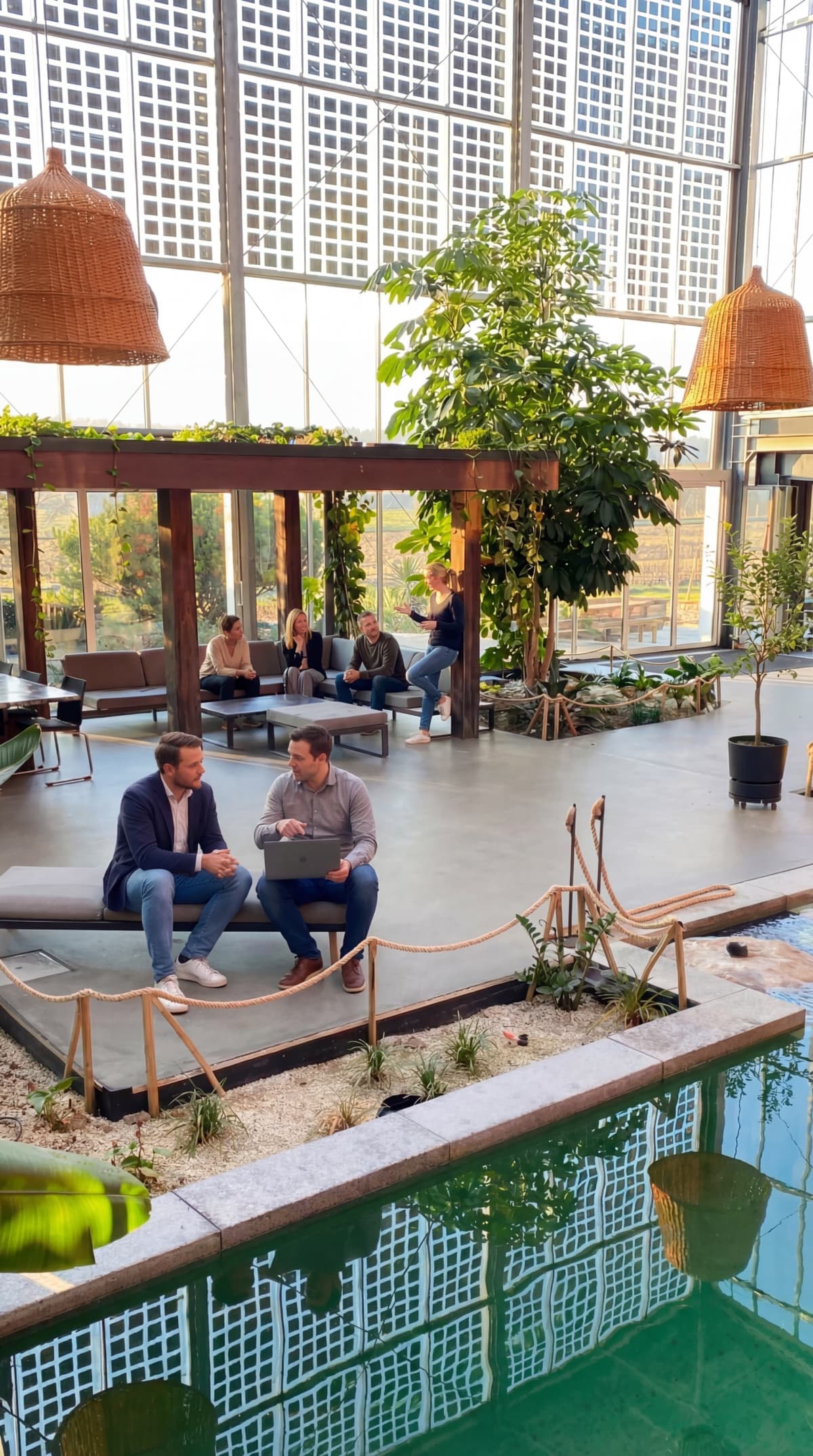
At Innergarden, I see this almost every day. The community forms in the atrium, outside in the greenery, over meals, at the regular events. Our 500 square metres are generous enough for focused work – and at the same time human-scaled enough that you genuinely meet one another.
What we mean by community at Innergarden
We didn't think of Innergarden as a place of work alone, but as a place where people like to be. That sounds simple, but it takes care. Because 'liking to be' somewhere means a place doesn't just function – it also feels socially coherent.
So we invite people who feel like being part of something – not just users of an infrastructure, but members of a circle they help shape. This excludes no one. It simply creates a context where belonging is taken for granted and doesn't have to be fought for.
Regular community events, an active member culture, and spaces that invite encounters are not add-ons for us. They are the core of what makes Innergarden – a coworking network near Offenburg that you'd sooner describe as a neighbourhood than as office space.
Takeaway
Work is more than what's finished by the evening. It is also a part of the social life we share with one another. A good shared place makes room for that part – not as a contrived programme, but as a natural part of the day. If you feel like connection, coworking offers a place where it can grow all on its own. And that is no minor side effect. It is one of the loveliest reasons so many people seek out doing things together.
Meet the Innergarden community: come for a day — no commitment needed.
Request a trial day →