

Some days I love my home office dearly. When my head wants to finish a quiet task in one clean stretch, there's little better than my own desk, my own coffee, and no one to interrupt. On other days that very same flat goes silent and a little too small – and I notice that a change of scene would do me good. So if you're weighing coworking against the home office right now, it's rarely about "better or worse." Both have real strengths. The interesting question is: when does each one shine – and what can coworking add when you want it?
What the home office is simply great at
Let's start with what many of us love about the home office: it's flexible, quiet, and shaped entirely around you. No commute, a familiar space, and you decide how the day runs. For deep solo work, confidential calls, or the morning when you just want to finish something in peace, it's often exactly right.
For the life around work, too, the home office is a gift. The laundry running in the background, picking up the kids earlier, lunch on your own balcony – these are real benefits, not workarounds. Plenty of people work genuinely well from home, and that's the way it should stay.
When the home office does run into limits, it's rarely down to you. It's more of a trade-off: the same space carries work, breaks, and the end of the day all at once. Sometimes the line between work and personal life blurs; sometimes it's the easy, in-person exchange with others that's missing. These aren't flaws – they're simply things a second place can balance out when you need it.
When coworking is a nice addition
Coworking doesn't replace the home office – it gives it a counterweight. On the days when your own four walls feel too quiet or too full of distractions, a place made purely for working can change a lot.
First: a clear structure. Getting up in the morning, heading out, and going somewhere built for work is a friendly signal to your own mind – the workday starts now, and in the evening the work stays there too. That boundary between work and home is exactly what takes more discipline at home; a coworking space hands it to you almost for free.
Second: encounters you don't plan. The short chat at the coffee machine, the tip dropped over lunch, the offhand "what are you working on?" Moments like these are hard to schedule – which is precisely why they're often so valuable. Anyone working mostly remote eventually misses them, without quite being able to name what's gone.
Third: energy. Sitting in a room with other focused people carries you through the afternoon you might have drifted off in alone. You don't have to talk to anyone; the calm, working atmosphere alone helps. So if you notice that focus, clear boundaries, or simply a bit of company are missing, coworking can fill exactly that gap – on the days you need it.
The hybrid rule of thumb: 3+2
Many people who work remotely settle, over time, on a mix that feels right: a few days of coworking or office, a few days at home. A popular version is 3+2 – three days out, two days at home. But that's not a law, just a starting point. Some need only one coworking day a week, others almost every day.
The appeal is getting the best of both worlds: the calm and flexibility of home, and the structure, connection, and energy of a shared place. At Innergarden, our flex-desk offering fits this: you book exactly the days you need – no long contract, no desk sitting empty the rest of the week.
Which setup fits which day?
Home office works well for short admin blocks, private appointments, and tasks that need little setup. Coworking is stronger for deep work, confidential calls in a quiet room, clear separation between work and home, or days when home simply lacks energy.
The company office remains strong for team days, onboarding, spontaneous coordination, and culture. The best setup is therefore rarely either-or, but a deliberate weekly plan: which task needs which place?
What Innergarden can add
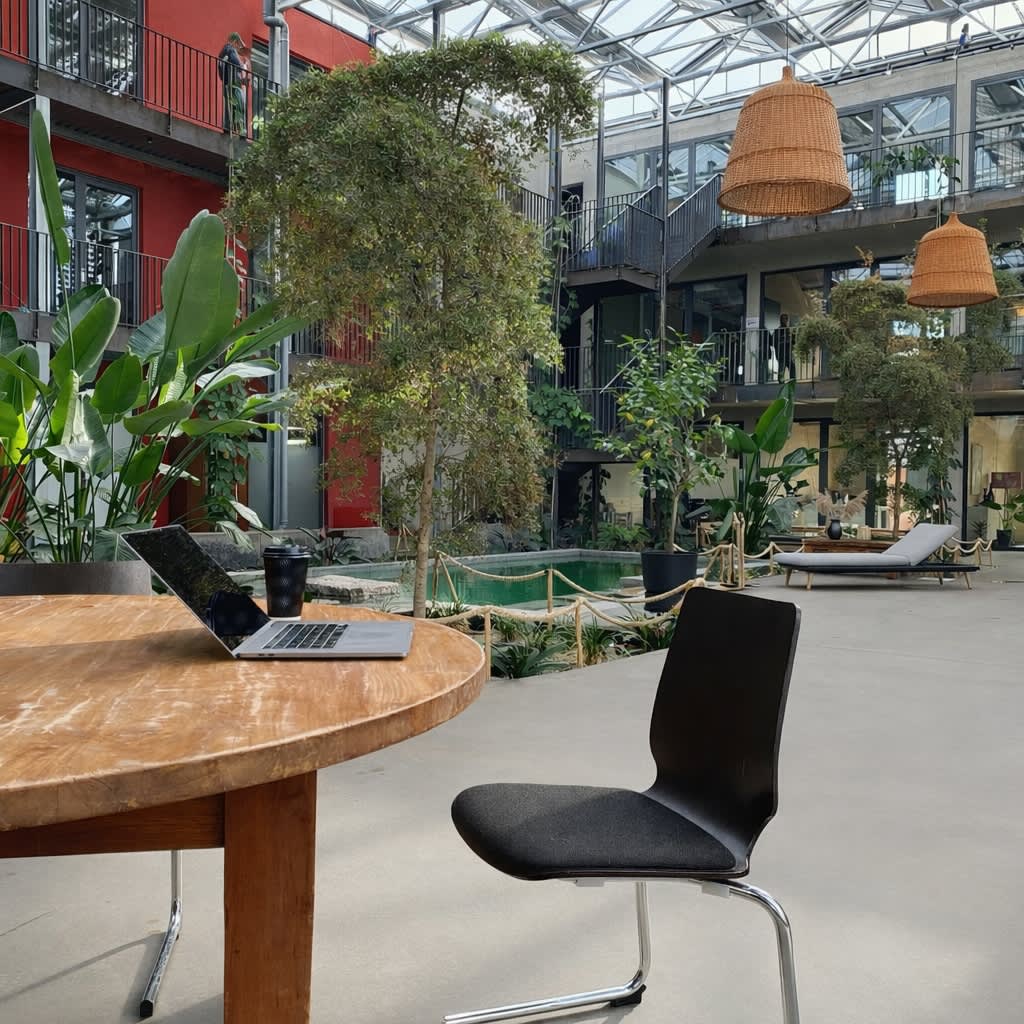
If coworking appeals to you, it's worth looking at how a place feels. Innergarden is deliberately small and quiet, set in the green just a few minutes from Offenburg. The natural pool, the garden, and the daylight through real windows aren't decoration – they make a workday feel noticeably lighter.
Behind it is a simple idea: the quality of the place feeds the quality of the work. When you feel good where you sit, you get into focus faster and often head home earlier and more satisfied. Whether your best place to work is your kitchen table, a quiet flex desk in the green, or a mix of both is something you're best placed to decide – ideally by trying it once.
Takeaway
Home office and coworking aren't rivals – they're two good answers to different kinds of days. The home office gives you calm, closeness, and flexibility; coworking gives you structure, connection, and energy when you're in the mood for it. You don't have to choose – you get to combine. What's most productive usually isn't the one right place, but the freedom to pick the one that fits the task.
Curious what working at Innergarden feels like? Come by for a free trial day.
Request a trial day →